
Low-Code vs Traditional Code
Which approach delivers the best value?

Low-code has emerged as a complete alternative to traditional development approaches, enabling teams to rapidly create and deploy saleable products without the need for extensive traditional coding. Unlike traditional development practices, which rely on writing code line by line and dealing with the complexities of managing a full codebase, low-code platforms like OutSystems or Mendix offer an ecosystem that significantly reduces development time and complexity. But is this convenience worth the ongoing expenses, especially when compared to the traditional, full-control development route?
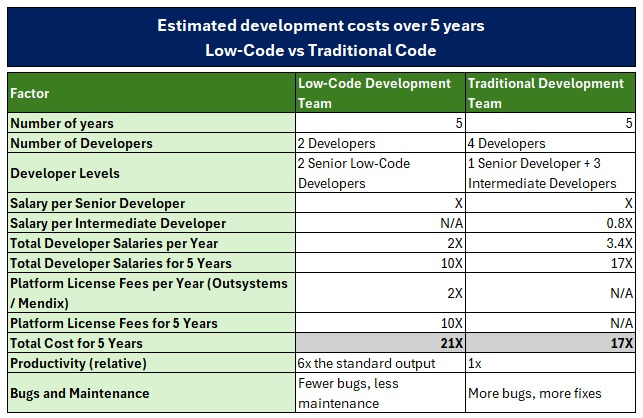
Choosing the right development approach for your product, low-code or traditional code, can be a tough decision. The decision impacts everything from the cost of development, to time-to-market, to how easily you can maintain or enhance your product over the years. To help illustrate the financial and operational implications of both options, here’s a cost comparison over a five-year period between a team of low-code developers and a traditional development team.

Disclaimer
Some types of products are simply not suited for low-code platforms, particularly those that require extreme customisation for non-standard components or where full control over the codebase is crucial. In many cases, a hybrid approach, using low-code for certain parts of the application while employing traditional development for others, can also be considered. However, this comparison is focused purely on a straight swap between low-code and traditional development for simplicity.
Productivity Multiplier Justification
The 6x productivity multiplier used here is based on experience comparing low-code and traditional development approaches. With one developer on each side, low-code development was observed to be about 4x faster due to the pre-built modules and rapid prototyping capabilities. However, when more developers are added to a traditional development team, production costs do not scale linearly due to the added coordination and integration complexities, which are less of an issue in low-code environments. Thus, for two low-code developers versus four traditional developers, the productivity factor has been adjusted to 6x, which is still a conservative number in my opinion.
Risks and Opportunities
When considering these costs, it’s not just about the numbers, each approach has unique risks and opportunities that need to be taken into account.
Low-Code Development: Risks and Opportunities
Risks
Platform Dependency: With low-code platforms, you are dependent on the vendor. If the platform changes pricing or discontinues features, you may find yourself locked into their ecosystem, facing unexpected expenses or limits.
Complex Customisations: Heavy customisation can become challenging with low-code platforms, as they may not support all of your desired features.
Developer Market: Finding experienced low-code developers can be more difficult compared to standard developers, especially when working with niche platforms.
Opportunities
Faster Time to Market: Low-code platforms excel in delivering rapid solutions, allowing you to launch new features and products much faster, which is crucial in a competitive landscape.
Scalability: Low-code platforms are often designed to scale easily, enabling faster adjustments to increasing loads or expanding business requirements.
Lower Maintenance Over Time: Fewer bugs and automated maintenance help teams focus on innovation and developing new features rather than spending time fixing bugs or upgrading technology stacks.
Standard Development Team: Risks and Opportunities
Risks
Slower Development: The traditional development approach often takes longer due to the need for building from the ground up. This can lead to delays and falling behind competitors.
Higher Maintenance Overhead: traditional code means a higher maintenance workload, as all bugs and issues need to be identified and solved by the team itself.
Recruitment Costs: A larger team can mean higher recruitment costs, and with more developers comes the risk of turnover and the delays associated with finding new talent.
Opportunities
Full Control Over Codebase: With traditional development, you have complete control over every aspect of your product, meaning you can tailor it precisely to meet your needs without any platform limitations.
More Flexibility for Complex Features: traditional development allows for complex, highly tailored features without the constraints often present in low-code platforms.
Developer Pool Availability: Traditional developers are more readily available compared to niche low-code specialists, making recruitment easier and providing a larger pool of talent.
Conclusion: Choosing the Right Path
Ultimately, the choice between low-code and traditional development is not just a financial decision, it’s also about strategic alignment. Low-code can be an excellent option if you need rapid delivery and can manage within the platform's limitations. On the other hand, if flexibility and full control are key priorities, a traditional-built solution may be the better fit.
The cost comparison shows that, while low-code can come with higher platform fees (leading to a total 5-year cost of 21X compared to 17X for a traditional team), the increased productivity and reduced bugs may balance these costs. As always, it’s crucial to consider both the financials and the unique needs of your product before making a decision.
Personal Take
I enjoy sharing my personal take on these topics, especially because they come from direct experience. I have a genuine love for low-code solutions, primarily because of the incredible speed you see from ideation to actual usage. In my experience, the complex customisations that are often cited as barriers to low-code adoption rarely turn out to be true roadblocks. If you can cover 90% of your solution with low-code and leverage traditional development for the remaining 10%, through embedded components or hybrid integration, then low-code is the right choice. It allows you to reap the benefits of speed and flexibility without sacrificing the ability to handle those last few tailored needs.
When it comes to balancing speed, flexibility, and long-term control, which development path aligns best with your team's vision and how do you see this evolving as your product scales?
I also invite you, the reader, to share your thoughts, corrections, and differing opinions. Don't hesitate to challenge my views, progress is built on collaboration, and I believe we all grow when we share, debate, and refine our ideas together. This publication thrives on open discussion, so your voice is essential.